Abstract faster. Report sooner. Stay survey ready.
OncoLens uses oncology-trained AI to automate case-finding and abstraction for registry teams to stay concurrent. Quality and accreditation reporting becomes real time and pro-active in nature.
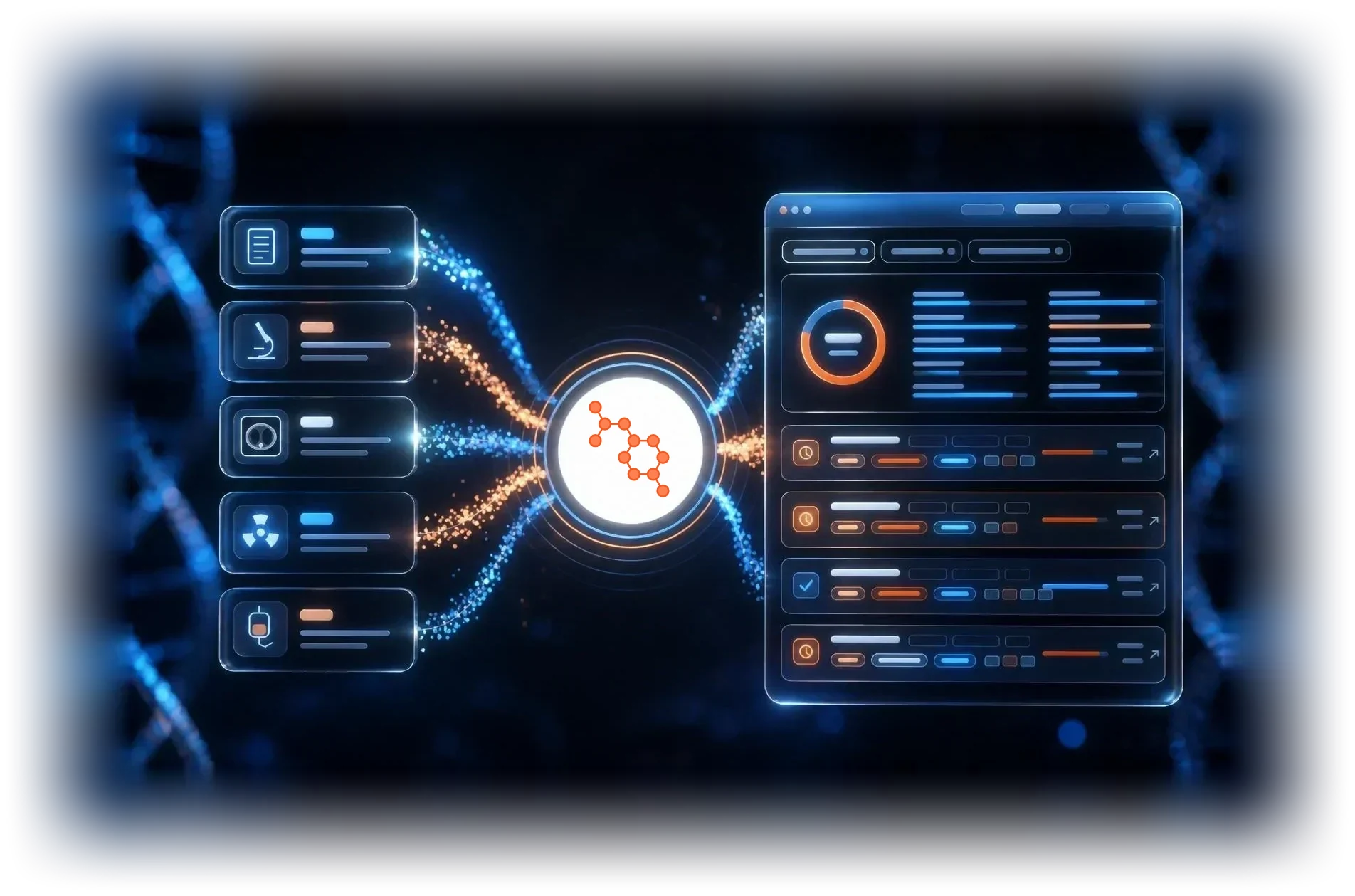
OncoLens results for Registry & Quality Teams
How OncoLens AI and your registry team work together
AI handles the reading. Registrars keep the judgment.
Registry automation and quality reporting in one place
AI-assisted casefinding
- Identify reportable cases in minutes, including patients missed by traditional pathways.
- OncoLens is trained to review those documents with 50+ pages to find the details needed.
Automated abstraction
- Extract staging, histology, biomarkers, and treatment from unstructured notes.
- Your ODS gets to review each result with the source information on hand.
Accreditation reporting
- Track CoC, NAPBC, NAPRC, and QOPI measures continuously instead of scrambling before survey.
- We deliver a digital compendium of reports for quality leads to thumb through and act on, immediately.
Quality improvement programs
- Monitor testing and treatment rates by site, cancer type, age, and race to target QIPs where they matter.
Tumor board compliance
- Reduce the burden of conference prep and related data collection through OncoLens Conference through the use of a standardized solution.
- Let your navigators be navigators and ODSs be data analysts and not data collectors.





































Case studies

How One Cancer Center Found 14 Missed Patients with the OncoLens Registry Report
An academic comprehensive cancer center in Florida used the OncoLens Registry Report and, within one week, identified 17 rectal cancer patients under age 50, 14 of whom standard systems had missed.
Read the full case study →
QIP to Increase Complete Lung Cancer Biomarker Testing Rates (ASCO 2024)
A quality improvement program to raise complete lung cancer biomarker testing rates by addressing system, physician, and other factors linked to adverse health outcomes.
Read the full case study →Frequently asked questions
What is AI-assisted cancer registry abstraction?
AI-assisted cancer registry abstraction uses oncology-trained models to find reportable cases and extract registry fields, such as staging, histology, biomarkers, and treatment, from pathology, radiology, and clinical notes. With OncoLens, each extracted value is shown with its source so the registrar reviews and confirms it.
How does OncoLens support cancer registry casefinding?
OncoLens reviews pathology, radiology, and clinical documentation, including documents of 50+ pages, to identify reportable cases, including patients that traditional casefinding pathways miss.
Does OncoLens replace the registrar’s judgment in abstraction?
No. OncoLens extracts staging, histology, biomarkers, and treatment from unstructured notes and presents each result with its source so the ODS can review and confirm it. The registrar stays in control.
Which accreditation programs does OncoLens support?
OncoLens tracks measures for CoC, NAPBC, NAPRC, and QOPI continuously, so quality leads can monitor performance year-round instead of preparing only before survey.
How much time can registry teams save?
OncoLens customers have seen a 40 to 75% reduction in data extraction time, freeing registrars to focus on analysis and quality work rather than manual data collection.
Explore other audiences
OncoLens supports every team across the cancer program.
Cancer Executives
Run your cancer program on real-time insight
AudiencePhysicians & Tumor Board Teams
Less time on prep. Confidence that no patient falls through the cracks.
AudienceNavigators & Care Teams
Clarity on every patient, ready for your care.
AudienceResearch & Clinical Trial Leaders
We get the complexity of Oncology trials.
AudienceIT, Data & AI Leaders
Oncology AI that scales with your needs and fits your governance.
Give your registrars an AI co-pilot.
See OncoLens abstract a case from real clinical documentation.